
Test Website Localization: Separate Proxy Region, Language, and Cookies
If changing the proxy region leaves a website's language or currency unchanged, the proxy is not necessarily failing. Localization may depend on exit region, language preferences, cookies, account state, and explicit regional selections. A small test matrix that changes one factor at a time produces more useful evidence.
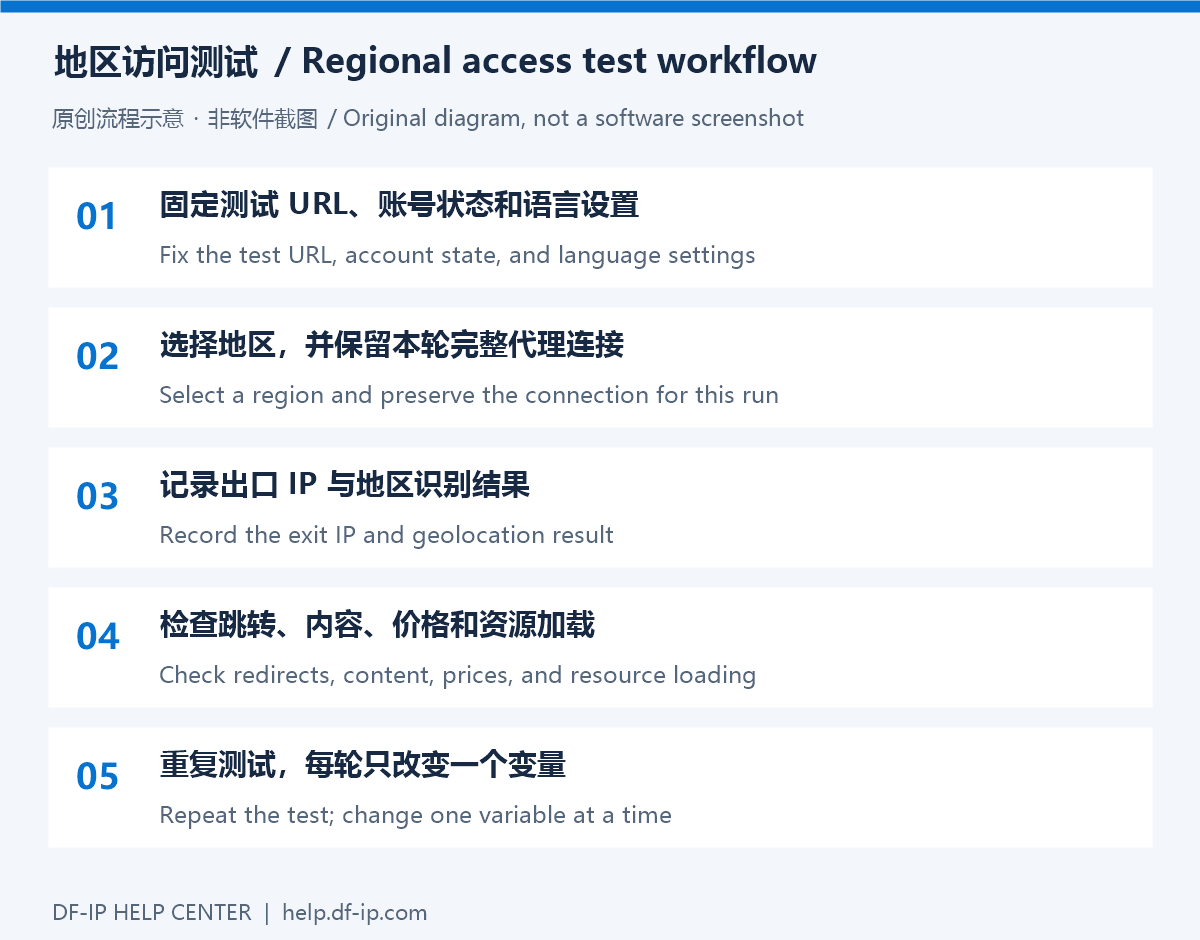
Build a minimal matrix
Regions A and B below stand for two relevant, currently available locations. They are not a promise of inventory in any particular region.
| Run | Proxy region | Language | Cookie/account state | Purpose |
|---|---|---|---|---|
| Baseline | A | Fixed language | Logged out, clean test profile | Establish the initial result |
| Region comparison | B | Unchanged | Equivalent initial state | Isolate exit-region influence |
| Language comparison | A | Another language | Equivalent initial state | Isolate language influence |
| Preference comparison | A | Baseline language | Save a region preference in the test profile | Check preference precedence |
Use dedicated test profiles rather than deleting data from a daily work browser. Record the starting conditions for every run.
Execute and record
Configure a connection using the browser tutorials and confirm the observed exit. Preserve the extracted dynamic connection within each run. Static residential proxies may suit repeated checks of an assigned exit.
Keep the URL, page version, time window, and login state fixed. Record any explicit region selector. Check language, currency, date formatting, content entry points, and the final URL; a flag icon alone is insufficient evidence.
Capture status codes for failed resources and reproducible steps for content differences. Keep credentials and real customer data out of screenshots. Return to the baseline before assigning the cause, accounting for cache state, deployments, and temporary network failures.
Interpret differences carefully
If the exit changed but the language did not, inspect language and cookie precedence. Different location-check services can classify an address differently; validate against the destination's actual business rules rather than treating one checker as a universal authority. If the target returns 403 or another refusal, record its response and use the normal support process. Repeatedly changing addresses is not a localization test.
Separate connectivity from business correctness. A reachable page does not prove that its product availability, price, or form rules are correct; those need their own assertions.
Get available connections from the DF-IP console. For the broader advertising-page workflow, read regional landing-page checks.